

An electric vehicle changes a home’s energy profile in one obvious way: it adds a large battery on wheels. It also changes the backup conversation. A household that once planned around a refrigerator, lights, and internet may now wonder whether solar, a home battery, and an EV can work together during outages and high-rate hours.
The International Energy Agency’s Global EV Outlook has described electric cars as a fast-growing share of global new car sales, and that growth is starting to show up in home electrical panels. The question is no longer just where to charge. It is when to charge, what power source to use, and whether the vehicle can support the home later.
Three Terms EV Owners Should Know
V2H means vehicle-to-home: power flows from the EV battery into the house. V2G means vehicle-to-grid: the vehicle can send electricity back to the utility grid under approved programs. V2E, often used more broadly, refers to vehicle-to-energy applications where the EV becomes part of a wider energy system.
These features require compatible vehicles, chargers, inverters, controls, interconnection rules, and safety equipment. A “big EV battery” alone does not mean a home can automatically use it during a blackout.
Why Solar and Storage Still Matter
Even if a future EV can power the home, a stationary battery still has a role. It can absorb midday solar, supply the house during peak utility pricing, and preserve EV range for driving. It can also keep smaller loads running without cycling the vehicle battery every time the grid flickers.
The Department of Energy notes that solar-plus-storage allows electricity generated during the day to be used later, including during an outage. For EV households, that can mean charging the stationary battery first, charging the vehicle when solar is strong, and holding backup reserve when storms are forecast.
Power ratings matter here. A Level 2 home charger can be one of the largest loads in the house. If it runs at the same time as air conditioning, cooking, or laundry, the electrical demand can spike. Smart controls can delay charging, limit current, or pause charging when the home battery reserve is low.
Building a Sensible Charging Plan
For most EV owners, the best setup is not “charge everything all the time.” It is a hierarchy:
- Keep a minimum home battery reserve for outages.
- Use solar production for daytime household loads.
- Charge the EV during low-rate or high-solar windows.
- Avoid draining the stationary battery into the car unless planned.
- Use V2H only when the vehicle and equipment are designed for it.
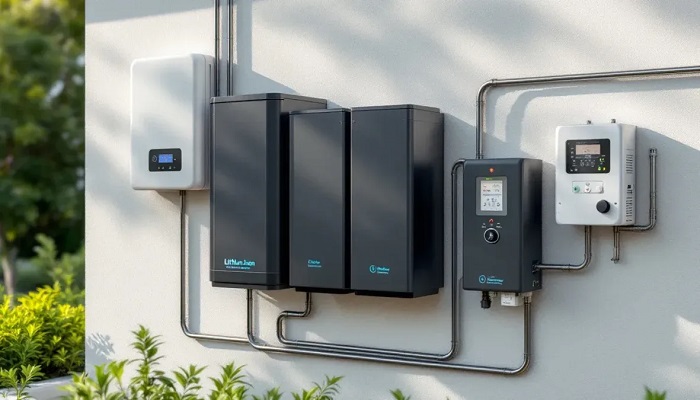
ESYsunhome’s EV22 V2E is a 22 kW EV charging product with V2H/V2G readiness, which makes it relevant for households thinking beyond basic charging. Paired with HM-series residential storage and energy monitoring through the ESYsunhome APP or Cloud, it fits the bigger idea: the EV, solar array, and home battery should act like one energy ecosystem, not three separate gadgets.
Outage Planning Needs a Driving Plan Too
An EV can be a backup asset, but it is also transportation. During a storm, wildfire evacuation, or regional outage, draining the vehicle may be the wrong trade. A stationary battery can keep the home stable while the EV remains ready to move.
For a commuter with predictable mileage, that balance may be easy. For a household with one vehicle, medical trips, or rural driving distances, backup rules should be conservative. The home energy system should know which load matters more at 2 a.m.: the car, the freezer, the heat pump, or the sump pump.
EV owners have more opportunity than most homeowners to lower energy costs and improve resilience, but the design needs discipline. Anyone comparing EV charging, V2H readiness, and home storage can use ESYsunhome EV22 V2E as a reference point for how vehicle charging fits into a broader residential energy plan.