

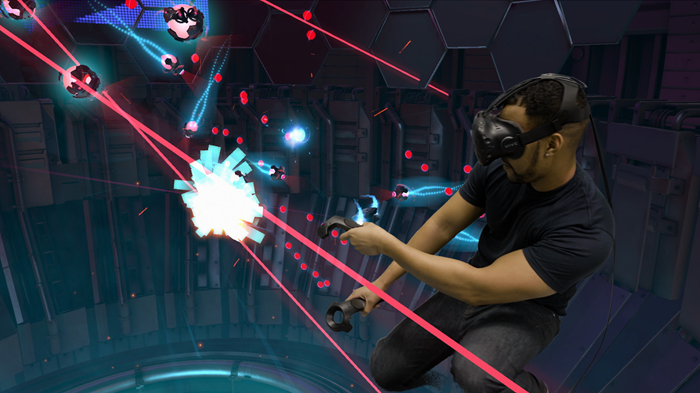
VR game development begins with an idea and a prototype: the team determines the genre, target platform, and how the player will interact with the virtual world, then quickly assembles a test scene to test comfort, controls, and pacing.
At this stage, it’s important to consider performance, frame rate, and tracking accuracy right away, as any lag or jerkiness in VR has a greater impact on the experience than in traditional games. Therefore, level design, animation, and sound are built around a sense of presence and safety.
The fundamental rules of VR development boil down to simplicity and predictability: the interface should be clear and uncluttered, movements should be customizable, and interactions should be logical and physically plausible. Testing is conducted more frequently and on different people to identify motion sickness, accessibility issues, and collision errors. This is precisely how projects that are featured on BATTLE START are created, where immersion, stability, and respect for player comfort are paramount. Pre-Production: Formulating the VR Concept, Interaction Scenarios, and Motion Sickness Limitations
During the pre-production stage of a VR game, the team defines the desired player experience: the role, the scale of the world, the degree of physical presence, and the purpose of using virtual reality (as opposed to a regular screen). The concept is formulated through the “user’s imagination” and the core action cycle: what the player does most often, what decisions they make, and how the system confirms these actions tactilely, visually, and audibly. It is important to immediately define the target platform and user conditions (room, standing/sitting, controllers, hand tracking), as these directly define the boundaries of interaction and the pace of the game.
At the same time, interaction scenarios are described as a set of “moments” and strict rules: how the player picks up objects, moves, opens the interface, receives prompts, and performs critical actions without overloading their attention. For VR, it is especially important to decide in advance which elements should be in the world (diegetic) and which can be relegated to the UI to minimize interruptions in presence. At this stage, a glossary of interactions is formed: standardized names for gestures, grip types, distances, object states, and expected reactions are established so that designers, programmers, and artists have a common understanding of the mechanics.
Motion Sickness Scenarios and Rules
VR sickness restrictions are transformed into design-level requirements, rather than a “late optimization.” In pre-production, the primary movement method is selected and the allowed modes are defined: teleportation, limited sliding, rail movement, movement through vehicles, in-place locomotion, and combined approaches. A list of prohibited techniques (for example, sudden camera accelerations without user control) is then compiled and exceptions can be made if justified and safe alternatives exist.
- Player-controlled camera: rotations and accelerations should be predictable; Discrete turns (snap turns) and adjustable speed are preferred.
- Stable reference points: environmental elements, the horizon, the “cockpit” or frame (vignette) help the brain maintain its bearings during movement.
- Minimum sensory conflicts: the greater the movement in the frame without corresponding body movement, the higher the risk of discomfort; This influences scene staging, animation, and level design.
- Comfort by default: comfort settings (rotation, vignette, altitude, dominant hand, sensitivity) are designed as part of the UX, not as a hidden menu.
- Test plan with thresholds: pass/fail criteria for comfort (session duration, frequency of sudden movements, acceptable acceleration) are defined in advance and include regular playtests.
The outcome of pre-production is a set of fixed decisions: a brief VR concept, a user scenario map, a list of interactions with rules, and comfort restrictions that cannot be violated during further development. The more precise these agreements are, the less risk there is of having to rewrite levels, redo locomotion, or “treat” motion sickness with crutches during production, which would impair gameplay and immersion.