

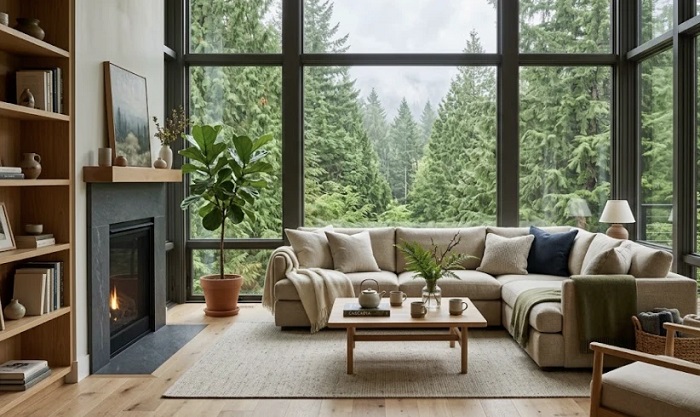
There’s a conversation that happens repeatedly when working on interiors in the Seattle metro area. Someone has a fabric sectional — usually something serious, a Restoration Hardware piece or a custom order, occasionally a high-end purchase from a showroom on the Eastside — and they can’t figure out what went wrong. The sofa is three years old. It looked right when it arrived. Now it looks like it belongs in a rental unit. Nothing specific happened. There was no flood, no catastrophic spill. The kids are allowed on it but aren’t rough with it. It just aged wrong, faster than furniture in any previous home they’ve owned.
This is not a story about sofa quality. The same trajectory happens across every price point in the Pacific Northwest, from a $600 IKEA piece to a $6,000 custom sectional. What determines whether furniture ages gracefully or badly in this climate has almost nothing to do with what you paid for it.
Why This Climate Is Particularly Hard on Fabric
Western Washington runs at ambient indoor relative humidity between 55% and 75% for most of the year, without active dehumidification. From October through March, homes on hillside lots in Bothell, Kirkland, and the Eastside corridor — especially older construction without modern vapor barriers — often push higher during atmospheric river events. What that number means for upholstered furniture is specific: at sustained humidity above 60%, fabric fibers absorb ambient moisture and create conditions where particulates embed more deeply and more permanently than they do in drier regions.
The fabric acts as a filter. Dust, pet dander, cooking vapor, wood smoke, and pollen all pass through the air in any home and some percentage always deposits on surfaces. In Phoenix or Denver, the low humidity means that same particulate load stays loose near the surface. In Seattle, the moisture helps it bind to the fiber. A good vacuuming session in Arizona removes what a good vacuuming session in the Pacific Northwest just redistributes.
The foam underneath the upholstery is doing something different but related. Cushion foam absorbs ambient moisture over time. The compression characteristics change — not dramatically at first, but noticeably after eighteen to twenty-four months of Pacific Northwest winters. Cushions that should recover in one to two seconds start taking three or four. The widespread “saggy couch” problem in homes here often has nothing to do with foam compression from body weight; it’s foam that’s been slowly absorbing atmospheric moisture since the day the piece was delivered.
Pollen season adds another layer. The Seattle area runs heavy alder, birch, and Douglas fir pollen from March through June. The first warm April weekend when people open windows after five months of a closed, heated house deposits more pollen on fabric surfaces in two hours than months of normal winter use. That pollen, once it hits humid fabric, doesn’t just sit on the surface — it embeds and starts to oxidize. The faint yellowish cast that shows up on light-colored sofas in direct window light after a few Seattle spring seasons is almost always pollen oxidation, not sun damage.
Which Materials Actually Perform Here
Performance fabrics with tight weave construction — solution-dyed acrylics, high-denier polyester blends, Crypton, Revolution, the upper tier of Sunbrella’s indoor lines — handle Pacific Northwest conditions considerably better than natural fibers. The closed weave structure resists particulate penetration and tolerates wet cleaning without the shrinkage or water-ring issues that plague linen and cotton-heavy upholstery.
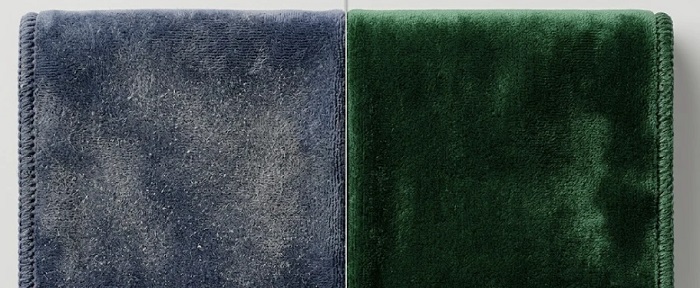
Velvet surprises people because it has a long history as premium upholstery material, and it does look exceptional in the right space. But the pile structure captures particulates at a rate three to four times higher than a flat weave of comparable weight. In low-humidity environments, consistent vacuuming keeps velvet viable. In the Pacific Northwest, particulates embed into the pile base at a depth that surface cleaning can’t reach. Velvet sofas in Seattle area homes that don’t receive annual professional cleaning look worn within two years — sometimes sooner in high-traffic family rooms.
Natural linen has become popular partly because of the organic aesthetic and partly because it photographs beautifully for real estate listings and interior design portfolios. It’s also one of the worst performers in this climate. Linen relaxes with humidity, developing a soft, slightly shapeless quality that reads as “worn” before the fabric has any real use hours on it. It also water-marks in a way that becomes visible in the flat, diffuse light that characterizes most Pacific Northwest interiors during the nine months of overcast weather — rings from condensation, humidity variation marks across the surface, splash patterns that dried and left a faint tide line.
Top-grain leather with proper finishing handles western Washington conditions well if it’s maintained. The problem isn’t moisture per se — leather has survived far wetter environments historically. It’s the thermal cycling: August in an Eastside home without air conditioning can hit 95°F interior temperatures, while November brings cold and damp. That swing dries out the surface of mid-grade and lower-grade leathers, causing cracking at seam lines and on cushion edges. Full-grain leather from quality manufacturers has enough natural oil content that it manages this better. Bonded leather — the budget category — doesn’t last a Pacific Northwest decade under any conditions.
What Professional Cleaning Actually Does
Most furniture manufacturers include care instructions that assume a dry-climate baseline. “Vacuum regularly and spot clean as needed” is adequate for environments where fabric isn’t actively filtering humid particulate-laden air year-round. In the Seattle metro area, it’s not enough for any fabric piece that sees regular use.
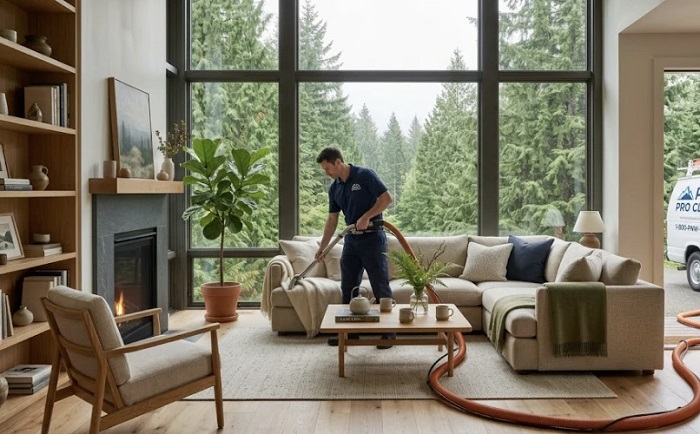
Hot water extraction — the truck-mounted systems, not the portable equipment you can rent — is the only method that extracts particulate matter from the base of fabric fibers rather than redistributing what’s near the surface. The operating difference is significant: truck-mounted systems run at water temperatures around 212°F and vacuum extraction pressures that portable machines cannot approach. The result is visible immediately in the extraction water after cleaning, and in the way the fabric looks and smells within twenty-four hours of drying. The piece doesn’t just look cleaner — it smells different, lighter, the way it did when new.
For fabric furniture in active Bothell living rooms with children or pets, the right cadence is annual professional cleaning at minimum. Pieces in lighter-traffic spaces can stretch to eighteen months in most Pacific Northwest conditions. The reason pet owners specifically can’t stretch the schedule is that pet dander and urine compounds penetrate fabric and foam at a depth that no surface method reaches; the enzyme pretreatment and heat of a professional furniture cleaning service in Bothell WA is the only practical way to fully address both the odor compounds and the allergen load at the fiber-base level.
The difference between truck-mounted hot water extraction and portable cleaning equipment isn’t subtle. The extraction water after a truck unit finishes a sofa that hasn’t been professionally cleaned in two years is dark, heavily loaded with what was sitting in the fabric. The sofa dries in two to four hours. With portable equipment, the extraction is lighter, drying takes longer because the machine couldn’t pull as much moisture back out, and the residue that’s left behind re-attracts dirt — which is why sofas cleaned with rental equipment often look good for three weeks and then seem dirty again faster than before the cleaning.
The Signs People Miss Until They’re Past the Easy Fix
The earliest sign that upholstery has been under-maintained in a Pacific Northwest home is an odor profile that’s hard to localize. A slight mustiness in the living room when the HVAC starts running in the morning, a mild off-note when someone sits down heavily on the sofa, a smell that seems to come from the general direction of the furniture but isn’t obviously identifiable as “dirty couch.” Homeowners attribute it to the dog, to the crawl space, to the duct system. In most cases, it’s the fabric furniture.
The smell develops gradually enough over months that the household adapts without recognizing the shift. When professional cleaning removes it, the contrast is clear — the room smells noticeably different within a day, and the household will often notice first that the smell is gone rather than the visual improvement.
The visual sign people miss is a flat, slightly grayed or yellow cast in areas of direct natural light. This is almost never sun fading — that takes longer and looks different in Seattle’s diffuse overcast light. It’s particulate oxidation on the surface fibers. At this stage, professional cleaning restores the original color. Once particulate oxidation has penetrated to the backing fabric, the change is permanent. The window between “reversible with cleaning” and “this is the color now” is roughly two to three years of no professional maintenance in Pacific Northwest conditions.
The furniture that stays genuinely nice in Seattle area homes — the pieces that look, in year seven, reasonably close to what they looked like in year one — is maintained on a schedule that accounts for what the Pacific Northwest actually does to fabric, not what the generic tag on the underside of the cushion was written to address. That means professional cleaning, the right equipment, the right cadence, and not waiting for an obvious problem before scheduling it.